• on having a miscarriage

    Lately, my thoughts have been pulled to a time in my life when I was 20 years old, freshly in a relationship with someone that I thought I loved deeply and knew I was terrified of losing. We had gotten together in kind of a rushed haze of summertime memories, sweet nothings whispered in moonlit swimming pools we had to find and sneak into. We had met at a party a few days after I had shaved my head for the first time. I had recently returned from a six-week writing workshop and was still fresh in my routines, reading and writing and thinking every free moment I had to myself. I was wearing a tank top and high-waisted circle skirt and kept smoking so many cigarettes, sometimes sneaking off to write in my journal.

    Somehow I felt powerful and beautiful, yet I remember being shocked when they asked for my number and messaged me that night to set up a next meeting. So used to being looked over, I felt uncomfortable that someone appeared to have seen me and even seen something they liked. We spent our first night together in a state of familiarity that suggested we knew each other before. Now I know we didn’t really know each other at all, were perhaps rushing a sense of intimacy because we thought there was something inside of the other that might save each of us.

    The power of their attention was so intoxicating to me that I felt obsessive in my love for them, which extended into me being overbearing—wanting them to drink less, wanting them to spend more time with me, wanting them to see how much I needed them to feel whole. All of this, of course, was unreasonable and unrealistic, for every person you meet will continue on as they are and have been and will only institute change within themselves if it is their own desire to do so. Codependency was a word I had never really heard or understood before, though I observed it up close in the behaviors of my parents and unknowingly absorbed it into my bloodstream.

    Our relationship unfolded in a predictable fashion: their initial interest sparked a heavy attachment on my end, and the more I needed their love and affection to keep me whole, the more they pulled away and grew distant from me. Most of our nights were spent sitting around drinking watery cheap beer, smoking cigarettes on their porch with their roommates, or hitting up a house show and continuously separating ourselves and coming back together throughout the sets. I hadn’t had my period in six weeks and hadn’t really thought of it, or perhaps I felt it lingering there behind my ears but refused to turn my mind’s eye to it. After all, I had classes to attend, shifts to work, and a life to keep together.

    Somewhere around this time, a great thunderous horror struck through my body. I’m not sure what class I was leaving at the time. It was certainly something related to English because I remember having to walk the sidewalk stretch from the writing building to the parking garage I left my car in. I felt a lightheadedness lift me out of my feet and a heavy pain settle into my uterine area. Of course, I assumed it was a period, nothing to be concerned about or to go to the health center for. As soon as I reached my car, it was as though the pain inside of my womb finally felt comfortable to reverberate throughout my body. I couldn’t think about driving or doing much of anything.

    The pain was growing in such a way that I knew I needed to be horizontal and immediately reclined the seat, writhing back and forth and sending a text to my partner that I would need help getting home. I couldn’t stop moving and rolling in place, somehow believing that keeping myself in motion could distract from the pain. There was a gush between my legs that was heavier and more dramatic than usual. It was as though something was being released from me. Time kept passing, and I heard nothing from my partner. I began to drift in and out of consciousness, the pain lulling me into momentary sleep. I remember at one point opening my eyes and seeing someone staring at me perhaps in concern but what I interpreted as judgment. After all, they didn’t help; just looked and kept walking.

    When my partner finally showed up, over an hour, maybe two, had passed, and all I could say in between moans was that I needed to get home. They started talking about their day and why they were delayed despite their class having ended a while ago. They had heard about a protest that would be occurring on campus and decided to sit in on a meeting. It turned out one of my writing professors was there, and they remarked how enjoyable and witty they found him. They wanted to get more involved, felt it was very important for them to be there. I’m not sure if I remember them asking how I was or caring much that I was in pain.

    When we arrived at their home, I immediately crawled into their bed, continuing my writhing and crying and moaning. I put my hand down my pants and came back to the air covered in blood. When I went to the bathroom, there was so much blood coming out attached to chunks and strands. I normally didn’t bleed like this on my period. There was an internal knowing that something was going wrong inside of myself, but I didn’t think to go to a doctor because I was used to enduring pain. Growing up, I was often accused of lying if I was sick, and I learned to suppress pain if I could so as to avoid being mocked or punished for it. Even now, I am never sure when I get sick or feel pain if I am deserving of taking the time to rest, recover, and feel through it.

    To add onto everything, my partner parted from me as soon as we got home. They wanted to practice playing the drums. As I bled out, I could hear them erupt the house with their rhythmic banging and thudding, taking a break every once in a while to grab something from the room. I’m sure they patted me on the back, kissed my forehead a time or two, but there was a distinct lack of concern for the pain I was enduring, as though it was just something that needed to pass in its own time. And perhaps this is true, but I will never forget that feeling of being scared, losing something inside of myself, and hearing them continuing on as normal in the next room.

    Realistically, this should have been the end of our relationship, but I had been taught to romanticize and normalize neglect through my relationship with my father, a man who loved me but was ultimately absent in my life due to his need to maintain his alcohol addiction. It seemed the less someone was really there for me, showing up in a way that wasn’t supportive and present and solid, the more I was able to reason with why they are like that and imagine all the ways I could win their affection or get them to change for me. For the most part, I don’t think too much about this moment in my life because it is too painful to look at how little I was being cared for by a person who was meant to care for me. It’s sad to envision myself alone in that room, wondering what’s happening to me or why nobody cares.

    The memory only resurfaced for me about a year ago when I started reading a book about the life and work of Jean-Luc Godard, EVERYTHING IS CINEMA, due to an interest I had in writing an essay about his work. I made it to the chapter on his film, UNE FEMME EST UNE FEMME (1961), which touches upon a time when his wife, Anna Karina, suffered a miscarriage in their home. The book describes her bleeding alone in a room while Godard is in the house working on his projects, doing other things. Suddenly, a rush of emotion fell over me and I realized the casual cruelty of what I had experienced. I closed the book and cried and never opened it again, the project idea ultimately being abandoned as I was left with the realization of what had happened all those years prior.

    I never realized how much more I deserved in that moment, that it’s actually not normal for your romantic partner to be able to ignore that you are in pain and continue on as though it’s any other day. I didn’t realize you could be so close to someone who ultimately cared very little for you. We never talked about that day, and the emotion of the memory makes it such that I have never been able to talk about it at length. The truth is I would have kept the child if the pregnancy stayed. I thought I was in love and despite my fear of repeating the patterns of my parents knew I had a deep capacity to love and nurture a child.

    Of course, our relationship fell apart in the ensuing weeks. Adding a pregnancy into the mix would have made the situation so much more chaotic and unhealthy than it already was, and who knows where I would be in my life now or what kind of hardships my child would have had to go through if I had taken that path. I can see now what happened was ultimately for the best because I was not ready to be a parent and my relationship with this person was not meant to last. We were simply supposed to cross paths for a brief moment and teach each other what we didn’t want going forward. But still, I sometimes think about who my child would have been, what passions would interest them, what they would be learning now, what our life would have been like together. Sometimes I listen to the song, “Baby Birch,” by Joanna Newsom and cry.

    I once had a checkup at the OB/GYN and in their preamble of questions was asked if I ever had a miscarriage. I had always said no to this question because I never went to a doctor after what happened to me, but I knew it wasn’t a normal period. I felt shame about never having talked to anyone or tried to get any help for myself. I didn’t care much about my health or safety back then, and part of me believed I deserved the pain in my life. I went through the highlights of the story: the pain, the duration, the lack of period leading up to it. I said I was never sure but it seemed like it was a miscarriage. The nurse confirmed that it sounded like that was the case to her, but there was no way to prove as much after the fact and without having had tests done. I said it was all good and that I had never talked about it before, so I didn’t know if it was something that could still be detected in my body. So many years had passed by that point.

    I was sent to wait in my room and when the doctor came in, she had been crying. She sat down and asked how I was. I don’t remember what I said or even what she said in return, but I remember her saying something about it being hard when you don’t have a chance to say goodbye. She hadn’t mentioned the story I told the nurse, and so I didn’t know if this was in relation to something she had just experienced or to my own story. This is something I still don’t know. But I remember being taken aback by her emotion and how numb I felt. I only ever allow myself to feel the grief of the experience briefly. It’s here and then gone. I go back to pretending it never happened. Yet it lingers in the background, the suggestion of another life, another timeline, another person I could be.

  • on returning

    “In a world that entices us to browse through the lives of others to help us better determine how we feel about ourselves, and to, in turn, feel the need to be constantly visible, for visibility these days seems to somehow equate to success, do not be afraid to disappear—from it, from us, for a while—and see what comes to you in the silence.”
    Michaela Coel

    It appears I may have been overly ambitious with my ideas and dreams for this blog and inadvertently ended up abandoning the project altogether either in a state of paralysis, overwhelm, or a mixture of both. Much has happened since I last wrote, much I never could have imagined for myself. And yet in the moment of experiencing it, I still find myself hesitating against the beckoning of self-pride, of truly honoring and valuing how far I have come and what it has taken to get here. No, it appears it is quite inbred in me to question myself, to not see what is really there and instead invest in what really isn’t. Perhaps if I hold myself in this awareness while giving thanks for what I have, a slight perspective shift may occur. Of course, the mind is a malleable yet stubborn thing.

    I recently chose to walk away from a career opportunity which at first felt like it may be a dream. For the first time in my life, I was being paid to write, given an opportunity to be creative everyday; to immaculately conceive and bring into life a vision unique unto me and only me. As I poured my love and soul into this project, I felt challenged by those around me. Someone on my team was not meeting deadlines, doing their fair share of work; was interfering with my work, micromanaging me in front of an overwhelmed supervisor who was too busy to know how anything was getting done. I was doing the work of several people with very little communication or support from those around me. A trend I noticed occurring was that the longer I toiled away, the more any compliment I received was attached to a request to take on more work, some of which didn’t fall under my list of responsibilities.

    I began to feel burnt out; to feel I was losing sight of myself, my vision, and my reason for being there. I had started the project because I wanted to bring people to our business, as things weren’t being promoted properly and patronage was dwindling. I quickly realized in taking on the project that the people I was working for were simply happy to reduce their workload but not necessarily interested in acknowledging my vision or understanding my purpose. Instead they asked me to do more things, became more silent, responded to less emails, and brushed away more of my ideas.

    I began to realize that while I was making their lives easier, they were making mine harder and not seeming to care or even be aware they were doing so. To top it all off, I was being paid $13 an hour before tax for highly skilled labor with no promise of a promotion or official role. The most my supervisor could offer was that they would bring up the idea to my head supervisor in several weeks, though there would be no promise of any improvement. At the same time, said head supervisor was giving credit for my work to someone who had done nothing and had in fact been not completing work for the past two weeks.

    It’s safe to say I hit a breaking point and ended up quitting in a somewhat sudden fashion. I had a conversation on a Friday about all of my concerns and quit the next day when I realized the situation had no chance of improving, which was further confirmed by the head supervisor responding to my concerns with a long email telling me to do things I had already been doing for weeks and trying to make me feel responsible for their own lack of communication while also not correcting their error in giving credit for my work to someone else. I realized quite suddenly—though I should have processed and slowed down my reaction to it all—that this was a work environment that would not recognize when I was doing well and would find ways to blame me when I was not doing wrong.

    I realize that many people outside of me may think my actions appear risky or reckless. In fact, I feel this could be said about many pivotal moments in my life where I have needed to walk away from a tower as it was crumbling beneath me. I think most people, when they see or sense something is wrong in their life, will hold themselves there a little bit longer, telling themselves they can change something about the circumstances for the better. And who’s to say if said improvement comes or not. Certainly, sometimes we can improve our circumstances. However, so often I feel we hold ourself in harmful environments or allow harmful behavior to continue almost in a state of denial, and nothing really ever changes or comes of it except our capacity to withstand the situation. I feel that this is not how I want to live my life.

    Perhaps those I was working with did not want to see what I was contributing, and perhaps the subconscious hope in their staying firm in that belief is that I will concede and settle for less, will stop asking for more. And this wouldn’t be a bad bet. I was raised by parents who taught me to question myself, who wanted me to believe I was bad and flawed and broken. I was taught that I couldn’t trust my own perceptions and judgments and understandings of the world around me. What I have learned as I have grown older is that I was not taught these things because they were right and just and true, but rather it was because the adults in my life did not want to see how they were causing harm and did not want me to see that I didn’t actually deserve it.

    It can be triggering to have this mirrored in relationships and group dynamics in adulthood. I question myself at times how these cycles keep repeating themselves. Certainly, a part of it is I have delayed processing due to ADHD, autism, and CPTSD, and so I often don’t realize how bad a situation is until it is starting to swallow me whole. But another large part is that I can put myself in a position of disempowerment because I am comfortable there. If you are told it is unacceptable to ask for decency and kindness your whole life, your entire livelihood will feel as though it is in danger when you are faced with a situation where you have to advocate for yourself.

    Thankfully, as I have gotten older and had to say no to more and more things, I have learned that it is worth it to choose yourself and trust that everything will somehow be okay or at least work out how it is meant to. This doesn’t mean there won’t be consequences for your actions or painful realizations about what you could have done differently or how you could have shown up better. But you take these things with you into the next experience and the next one, hopefully finding a more mature and authentic expression of self as you step onto your new path.

    I am still recuperating, healing, and surveying the damage of what has been lost. I walked away from something I didn’t want to walk away from simply because I knew the situation would not get better, and my mental health was at risk if things continued on as they were. Though I am not sure where my path leads next, what I have decided is that from now on, I refuse to give up on myself. If no one else believes in me, I will believe in myself. If no one else treats me with respect, I will respect myself. I choose to walk away from situations that harm me. I choose to value the work I have done, to believe I deserve fair compensation and communication and support. I choose to see reality for what it really is.


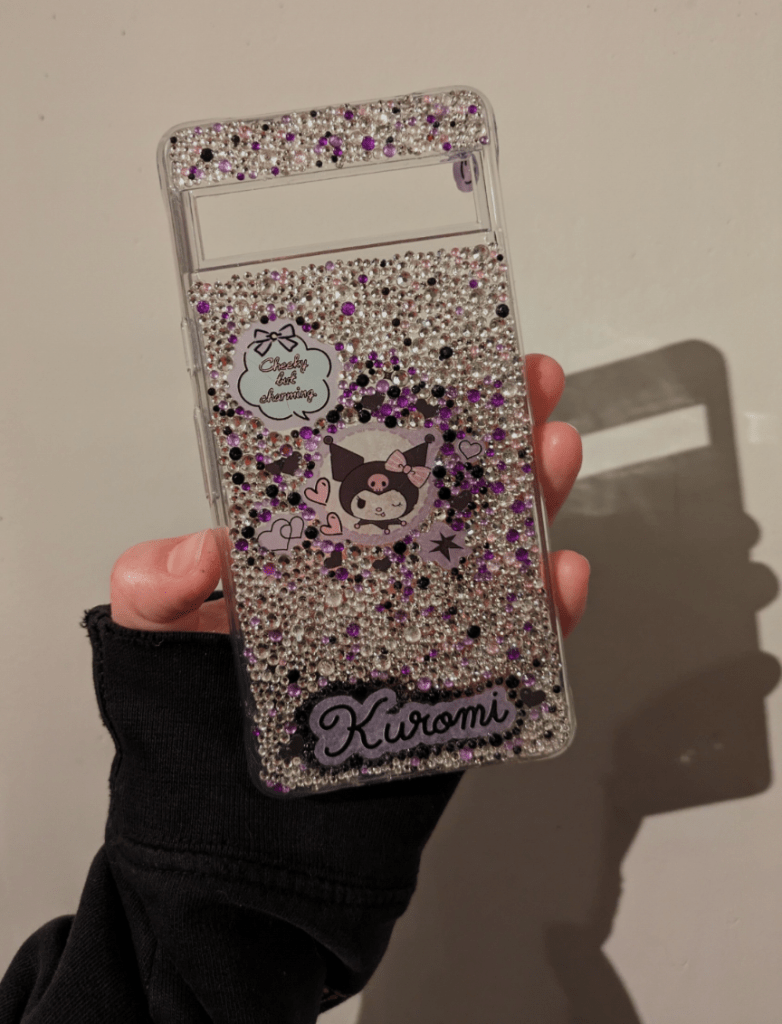
  • on bedazzling a phone case

    Image Description: A hand holds up a phone case that is covered in clear, purple, pink, and black rhinestones, as well as stickers of the Sanrio character Kuromi.

    Growing up, I had a tumultuous and pained relationship with my mother and, as such, desperately craved the attention and approval of my father and brother. In the pursuit of this, I often turned my back on my own interests or, even worse, felt embarrassed of them, only allowing myself to explore them in moments of privacy and solitude. I loved pop stars and their luminescent body glitter, dreamed of creating a cartoon-character aesthetic, craved for someone to show me how to style my hair and do my makeup. Yet all this yearning went unanswered even by myself.

    Raised to understand myself as being a girl (and currently understanding myself as non-binary), I was subtly taught to reject femininity in the way that all women, or people perceived to be women—and if we’re being honest, men—in a patriarchal world are taught that femininity is innately inadequate. Perhaps fueling my willingness to reject this part of myself was that I had already been programmed to believe in my own inadequacy by way of my own upbringing. But that’s a story for another day.

    You see, pop stars are fun, but they aren’t to be taken seriously. People who style themselves and wear makeup are vain and seeking attention. Small insidious comments like these teach one to question themselves and their reasons for doing things, thus taking away one’s own agency and giving it to the role of the observer. I began to feel ashamed of my interests, unsure of my reasons for doing things. I wanted to dress up and wear makeup because it looked fun, because it was a way to creatively express oneself. Yet in a moment’s notice, those reasons could be swiftly misinterpreted as proof of some sort of psychological injury.

    As a result, we begin to close ourselves off from things we love doing, things that help us merge parts of ourself into one distinctive, fulfilled whole. The only way out of this entrapment is through the repeated and persistent questioning of how things are and how they came to be. Eventually, you will come to a resounding conclusion: why should I live my life for a person or people that watch and judge my actions against pre-existing oppressive ideals, as a result never exploring the truth of their own authentic expression? In other words: don’t let the man get you down.

    As I have done some healing work over the past few years, I am slowly starting to interact more with my inner child, both tending to the unmet needs of my younger self but also exploring some of the very interests I used to reject. As such, I have found myself listening to pop stars from the ’90s and learning to do winged eyeliner on hooded eyes, putting thought into my outfits and taking up a new crafting project every week. It has been incredibly nourishing to my spirit, allowing me to feel a bit lighter and freer and accepting of who I am.

    On a bit of a whim, I purchased a small bedazzling kit on Amazon. After about a week of visualizing ideas, I finally settled on blinging out a clear phone case that I had purchased the month prior. I gathered together some stickers featuring Kuromi, a punk-rock rabbit-esque Sanrio character, and went to work. After two days of bent-kneck hyperfixation, I sealed and dried out this beautiful bedazzled creation that I wish to share with you, dear reader.

    I can never quite get over the feeling of satisfaction that comes with having created something. Sometimes the feeling is so beautiful, you want to keep it to yourself. But I hope in sharing my little bit of joy with you that it helps you to perhaps explore what it is that calls to you. What did you used to love doing as a kid? Why not give it a try after all this time? After all, it could be fun~


  • on art (and its many echoes)

    I’ve been ruminating as of late on the potential that a piece of art has to skip and ripple across the outstretched water of one’s life. I recently had the good fortune to see Pedro Almodóvar’s 1999 film, All About My Mother, which thoughtfully explores and monumentalizes this concept. In the film’s opening act, we are met with a great tragedy. Manuela, a nurse who oversees organ transplants, takes her son Esteban, an aspiring writer, to see a production of A Streetcar Named Desire for his 17th birthday, a play she once performed in with a community theater and whereby she met Esteban’s other parent, Lola. Following the performance, Esteban chases after a taxi in the hopes of getting the lead actresses’ autographs but is instead horrifically clipped and killed by a passing car in what appears to be an instant. Manuela soon approves the organ transfer of her son’s heart and resigns from her job, redirecting herself on a path to Barcelona in search of Lola. 

    Through a series of chance interactions and meetings of fate, Manuela soon finds herself crossing paths once again with the two actresses in the taxi on the night of her son’s 17th birthday. She begins to work for them as an assistant and unexpectedly performs as an understudy one night, which leads to a fiery and paranoiac confrontation in which Manuela is accused of being akin to Eve Harrington. Manuela finally admits to the thread connecting them all: that they were all together the night her son died; that she was drawn to them, to this play, once again, for a reason. “A Streetcar Named Desire has marked my life,” Manuela explains. 

    What interests me is that the appearance, and perhaps emergence, of the importance of this play in Manuela’s life serves as some kind of intuitive path-maker. Each interaction with Streetcar results in a fortuitous unfolding for Manuela, bringing with it changes that are both awe-inspiring, meaning-making, and catastrophic: marriage, birth, separation, death, community. It struck me how essential art can be in allowing us to create our own mythologies, in allowing us to make sense of the chaotic unfoldings of our own lives.

    I began to think of the films that have reverberated across my own path. There are admittedly too many, for reasons and occurrences both large and small, to fully get into here, as I almost feel my entire life has been shaped by my interaction with art in all its various forms. But what I’ve found most precious and hard to put down is the connection one can form to a person, an artist, who lived in a different time, who will never know what life is like in this current time, but who somehow reaches into something universal and human inside of us. Somehow they can reach down inside of us and say, “I know what it’s like to be a bit like you.”

    This is not something to be taken lightly or to be ignored. In fact, it can save one’s life to find the people that speak to them in this way. There have been countless artistic shepherds who have found me when I needed them and continued to find me when said need resurfaced years later: Arthur Russell, John Ashbery, Fiona Apple, Sufjan Stevens, Louise Glück, Franz Kafka, to name a few. It is my hope to explore the context in which some of these artists, some movies and shows and plays and books, have provided meaning throughout my life in some coming posts, or perhaps even just to explore the memory of one specific artistic experience during one specific time in my life. This series will hopefully be an invitation for self-examination, but anyone who stumbles across this is welcome to look-see.


  • (briefly) on grief

    Every year between the start of the New Year and the middle of March, I am pulled into a vortex—or at times a void—of remembering the passing of my late father in February 2010. I was 16 years old, dreaming of standardize-testing my way out of Florida, and coming into the growing realization that not everyone had a father that drank alcohol the way mine did. In fact, for much of my early life, I’m unsure I understood it could be a problem to drink—that it wasn’t something one did alone, that one should limit the amount they consumed—such that when I made it to college, I drank with ignorant aplomb, with almost no rest between drinks, blacking out regularly and not knowing it wasn’t necessarily supposed to be like this. Alcohol was a constant fixture in my father’s life, the omnipresent background character of my childhood, and a phantom albatross around the neck of my adulthood.

    As such—and as is the case, I’m sure, with many people who know grief—my memory of my father is quite complicated. He was complicated. At his best, he was caring and jubilant, someone who nurtured and provided for those he loved. He was the person who walks into your local cafe and knows all the regulars; the friend who cooks elaborate meals and plays card games into the night; the dad who dresses up in drag for a middle school cabaret performance because their daughter is really into Hairspray. In his shadow, there was pain, escape, criticism, shame. That is to say: he was human; he could be a real asshole. But he wanted to be your angel. The result was a kaleidoscopic sense of self that was frequently fluctuating but so beautiful when it caught the light.

    I think he shied away from embracing the darker aspects of himself, though I believe he was fully aware they were there and aware of how he pushed that awareness away. I understand why he did this. I think this is a thing most humans do. We don’t want to see the ways in which we are not who we tell ourselves we are. Perhaps there is fear that if one acknowledges their own darkness, power is being given over to said darkness. But really, the things that have the power to consume us—like addiction, like illusion, like shadow—are best controlled when they are kept under a watchful eye. If the alcoholic pretends that this one drink won’t lead to the next, they have already surrendered themself over to flow of drinks that follow.

    What stings and what lingers is I can never have these conversations with him; can never look him in the eyes and say, “I’ve spent my whole life learning what it means to understand you.” Instead I speak to his ghost and the candle flame. I keep an open seat next to me at the movie theater. I carry his broken 007 roulette watch in my pencil pouch. I imagine if he never went braindead when being transported out of the ICU, what it would have meant for him to recover. My favorite way to imagine him is during a group share in an AA meeting. I can see him now with his styrofoam cup of coffee, chewing on Eclipse gum to satiate his nicotine cravings, and opening the room up with laughter. He would have belonged there. Anyone who knew him knew he always had something to say.